Art in Ephesus
Art is the way human emotions, thoughts, and imagination are expressed. In Ephesus, art manifests itself in all aspects of life, from sculptures to architecture, and from paintings to everyday objects; the city carries traces of creativity and aesthetics from the past to the present.
Art in Ephesus
In ancient times, Ephesus was not only a center of trade and faith but also a remarkably vibrant city in the realm of art. The people and their rulers spared no expense to beautify their city, and above all the Temple of Artemis, the symbol of the city, and they placed great importance on art. As a result, many sculptors and painters enjoyed patronage in Ephesus, adorning both the public spaces of the city and the interiors of its homes with their works.
The Art of Sculpture
A marble copy of the statue of Ephesian Artemis (2nd century AD) is striking for its depiction of multiple breasts symbolizing the goddess’s abundance. In Ephesus, the art of sculpture flourished particularly around the Temple of Artemis. This temple, counted among the Seven Wonders of the World, was furnished with works by the most famous sculptors of the age. Ancient sources state that religious statues by renowned Greek sculptors such as Polykleitos, Pheidias, Kresilas, and Phradmon were displayed in the temple. Even the gilding of the temple’s columns with gold and silver made art and architecture merge into a magnificent whole. The figures of the Amazon warrior women, as the legendary founders of the city, were an especially popular subject for sculpture in the temple. Indeed, according to tradition, five master sculptors in Ephesus held a competition to create the most beautiful statue of an Amazon; in the vote they held among themselves, each placed his own work second, and so Polykleitos’s Amazon was chosen as the winner. This anecdote shows that sculptors competed to create the finest works and that there was a spirit of artistic rivalry in Ephesus.
Among the works unique to Ephesus were the cult statues of Artemis. The statues of Ephesian Artemis, adorned with numerous round protrusions symbolizing the goddess’s fertility, are iconic works reflecting the fusion of Anatolian tradition with Greek aesthetics. Some Roman-period copies of these marble cult statues have survived to the present day and are exhibited in the Ephesus Museum in Selçuk. In public spaces, too, there were many statues, from temples and agoras to monuments along the streets. For instance, fountains, monuments, and statues of gods lined the city’s Curetes Street, turning the city into something like an open-air museum. This rich sculptural heritage was a sign of the value the people of Ephesus placed on art.
The Art of Painting
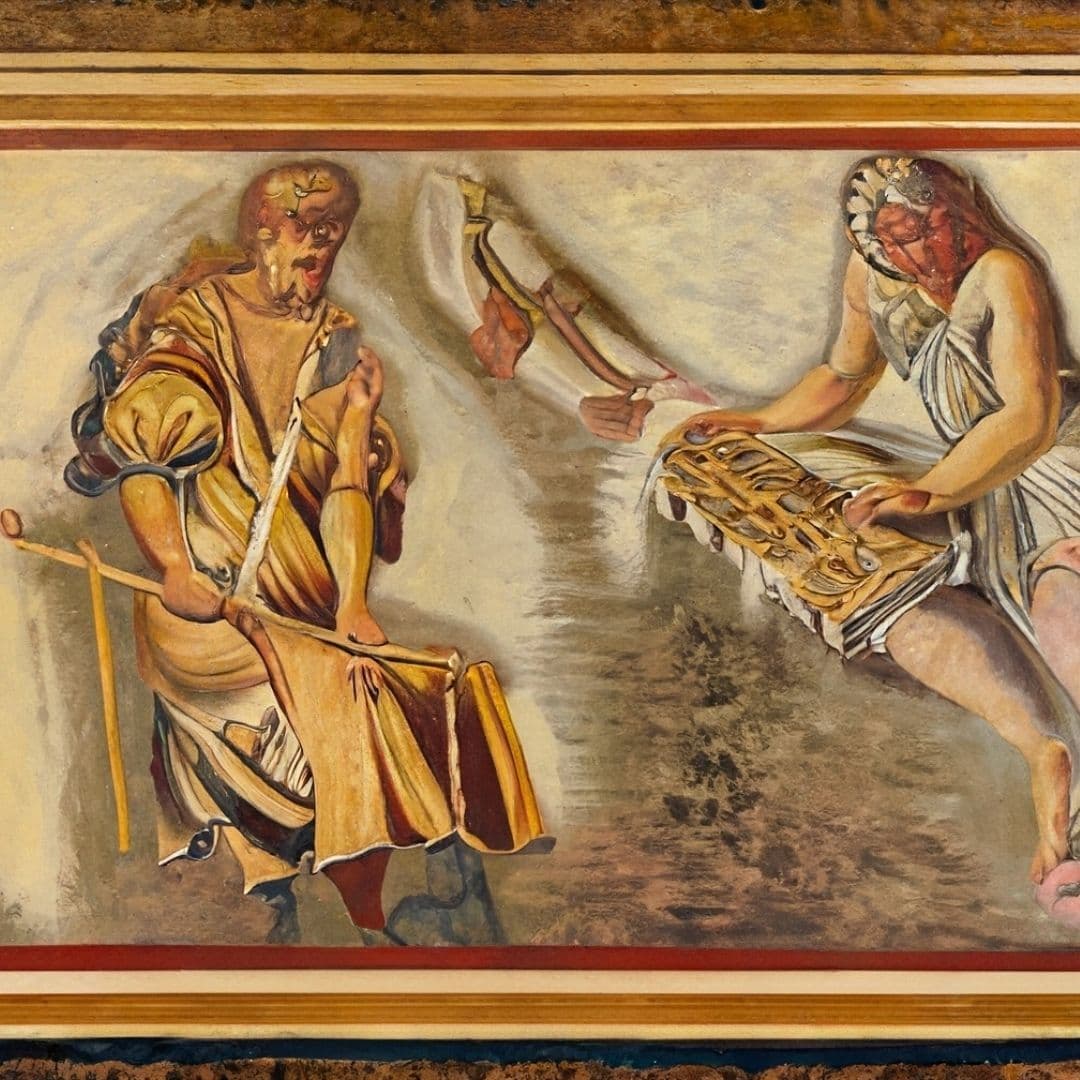
Wall paintings (frescoes) and a floor mosaic inside a wealthy “Terrace House” in Ephesus show the place of art in the daily life of the city.
In antiquity, Ephesus was a city known not only for its sculptors but also for its painters. Parrhasius, who lived in the 5th century BC, is among the most famous painters born or trained in this city. According to ancient sources, Parrhasius was regarded as the “foremost” painter of his age, and thanks to his mastery of line, he succeeded in giving his figures a sense of depth almost like that of relief. Renowned for his skill with color and illusion, Parrhasius is famous for the trompe-l'œil story in which he deceived his rival, the painter Zeuxis, with a curtain painted on canvas: Zeuxis was fooled as he tried to draw aside the curtain he believed to be real. Ephesus, which produced artists of such skill, was one of the centers of painting in the ancient world. From the Hellenistic to the Roman period, Ephesus was also closely associated with the famous painter Apelles. Born in Colophon in Ionia, Apelles began his training as a painter at a young age in Ephesus and then perfected his art at the famous school in Sicyon. Celebrated as the court painter of Alexander the Great, Apelles painted his famous picture of Alexander holding a thunderbolt specifically for the Temple of Artemis in Ephesus. This magnificent portrait (the Keraunophoros) was bought by the temple for a high price and placed there as a work emphasizing Alexander’s divine power. Ancient writers also mention, among Apelles’s finest paintings, a scene of a procession of Artemis in which the goddess’s statue is carried through the streets on the shoulders of young girls. This shows that painting held an important place in Ephesus, from temple decoration to cult ceremonies.
Painting in Ephesus was not confined to public and religious spaces; art was present in everyday living spaces too. The frescoes (wall paintings) adorning the walls of wealthy Ephesian homes and the mosaics on their floors were especially striking. Excavations of the wealthy terraced residences known as the Terrace Houses have revealed that in the 1st and 2nd centuries AD these homes were decorated with brightly colored painted panels depicting mythological scenes and with geometric or figurative mosaics. Each of the painted panels on the walls of these houses was regarded as a small masterpiece and reflected the aesthetic taste of the wealthy of antiquity. The mosaic floors, likewise of fine workmanship, reveal the elegant artistic style of Hellenistic and Roman Ephesus. In short, art in Ephesus permeated the entire fabric of the city, from its temples to its streets and the interiors of its homes.
Art Competitions and Stories
One of the signs of how vibrant art was in Ephesus was the rivalry among artists and the great interest the public showed in artistic events. The Amazon statue competition mentioned above is one example: the sculptors competed with one another to produce the best work, and in the end more than one outstanding work emerged. Likewise, competitions held as part of festivals, along with music and theater performances, kept the people of Ephesus close to the arts. The fact that the Roman Emperor Commodus at one time lent his name to the festivals of Artemis and organized games is further evidence that the world of art and spectacle was supported in Ephesus.
Ancient historians also recorded stories about Ephesian artists that passed from mouth to mouth among the people. One of them is the witty tale of revenge by the painter Klesides, which became an Ephesian legend. As the story goes, when Klesides was treated with contempt by Queen Stratonice, who had invited him to paint her portrait, he responded by making two paintings that humiliated the queen. The painter displayed these mocking pictures, which showed the queen in an intimate pose with a fisherman, on the palace wall for all to see. The people of Ephesus flocked to see the paintings, and great crowds gathered; the queen, for her part, had to hide her anger and pretend to admire them. It is also said that the queen did not have the paintings taken down for a long time, and even accepted them, saying, “The painter has portrayed me very well indeed.” The story of Klesides is a striking example showing that art in Ephesus was not only an aesthetic but also a social force, and that an artist could aim humorous criticism at rulers with nothing but a brush. The public’s interest in the affair also reveals how fond the Ephesians were of artistic expression and spectacle.
Related
(You might also like)